Why aren't UFO hoaxers sent to jail? Making false reports to law enforcement agencies is a punishable offense but hoaxing a UFO is not a crime under any known local, state, or federal statute. Even if it was, the United States Air Force has never had law enforcement jurisdiction except on their own bases and installations. Project Blue Book was given the job to investigate UFOs including reports from civilians, but there was a policy preventing them from exposing hoaxers.
Our investigation began while pondering a statement from the Department of Defense’s
Office of Public Information (OPI). Pan American pilot Captain Bill Nash was a
witness and UFO advocate with questions for the Air Force. In a reply dated July
16, 1954, Captain Robert C. White replied saying:
"As stated in the
enclosed fact summary, it is contrary to our policy to identify hoaxes in order
to avoid embarrassing innocent parties."
 |
| From UFOs: A History 1954 June-August Supplemental Notes by Loren E. Gross, page 30. |
The reprint of the letter didn’t not include the “Fact Summary,” so the hunt was on. The Air Force UFO files mainly concentrate on their investigations, not policy, but a few examples were found. The following material is best viewed as exhibits in an evidence folder. Not a comprehensive collection, a folio of some of the key suspects and prime offenders.
The 1949 Flying Saucer Cover-Up
Project Blue Book files contain a report from Nov. 3, 1949, about the Air Force’s investigation of Mikel Conrad’s UFO story. Conrad starred and directed in the film The Flying Saucer and he promoted it with the claimed that it featured real footage of a real saucer filmed in Alaska. |
| The Pittsburgh Press, Sept. 18, 1949 |
When questioned, Conrad admitted it was to promote the movie, “not a reality.” The reports stated that Conrad asked them not to reveal “the fact that the saucer is a hoax,” which would hurt its take at the box office. They agreed. “OSI had no interest in his picture, since he had not actually sighted any unconventional object in the sky.”
By the early 1950s, the Air Force estimated that less than 2% of UFO reports were due to hoaxes, but the phonies caused a disproportionate amount of effort to investigate. A review of the UFO cases listed in Project Blue Book files shows that the hoax label was most often applied to cases where photos or alleged UFO physical material were determined to be false. Many of the cases without physical evidence were evaluated as “Insufficient Evidence,” or Psychological.” The USAF developed a policy that no matter what the nature of the report, the names of witnesses were to be kept confidential.
The Public Disclosure of the USAF Hoax
Policy
Science Service Staff Writer Allen Long interviewed an unnamed spokesman for the Air Force on the saucer issue for a Oct. 12, 1953, syndicated newspaper article. (Later reprinted as Science Digest Jan. 1954, "The Air Force Looks at 'Saucers'" and in Great Adventures in Science, 1956.) Long wrote:
“… the mystery apparently is made to grow deeper by an Air Force policy of not discrediting a person or organization. ...If the experts conclude that the sighter had hallucinations or that he deliberately concocted a hoax, the Air Force remains silent rather than discredit the person who turned in the report. No official statement is issued saying the sensational sighting was bunk.
This assures the Air Force that other persons will continue turning in legitimate reports without fear of other persons will continue turning in legitimate reports without fear of public ridicule. It also means the Air Force will continue receiving a certain number of red herrings.”
 |
| As reprinted in in Great Adventures in Science, 1956. |
A few months later, this policy acknowledged in an official disclosure. The "Fact Summary" sent to Capt. Nash mentioned in our opening was actually the "Fact Sheet" issued in late 1953 (reprinted as “Plenty Going on in the Skies” in US News & World Report Jan. 1, 1954) which stated:
"The names of the persons involved in the sightings are withheld in respect of their privacy. They are free, however, to say what they please."
[And three paragraphs later,] Although hoaxes comprise but a small percentage of total reports, some of them prove to be the most, sensational and the most publicized. However, to insure that the Air Force will not embarrass individuals or groups who are sincere in their beliefs or who may be victims of such hoaxes, the facts brought out in the investigations of these false reports are generally not made public. Unfortunately, this policy has often given the erroneous impression that the Air Force is deliberately denying or withholding. information which, if revealed, would prove the existence of ‘saucers'."
 |
| US News & World Report Jan. 1, 1954 |
Captain Edward J. Ruppelt
In 1951, Captain Edward J. Ruppelt took over as head of the UFO investigation by the U.S. Air Force, and in 1956 wrote a book, The Report on Unidentified Flying Objects.

In the foreword he stated:
“In many instances I have left out the names of the people who reported seeing UFO's, or the names of certain people who were associated with the project, just as I would have done in an official report. …This policy of not identifying the ‘source,’ to borrow a term from military intelligence, is insisted on by the Air Force so that the people who have co-operated with them will not get any unwanted publicity.”
Ruppelt’s personal files included material used in the preparation of his book, and a few of them shed light on the policy. Ruppelt got into hot water over a hoax accusation in 1952.
 |
| Shell Alpert - Sunday Herald Aug 3, 1952 |
Seaman Shell R. Alpert supposedly photographed four UFOs above the Coast Guard Air Station at Salem, Massachusetts, on July 16, 1952. The New York World-Telegram and Sun reported on July 30, 1952, “Without questioning anyone’s integrity, Capt. Ruppelt said his first impression was the picture is a fake. He said the alleged saucers appear to have been painted in.” The Blue Book card for the case selected the box, “Unknown,” with comments stating, “open to doubt.” The monthly case listing booked it as “Unidentified.”
Ruppelt’s notecard on the Shell Alpert case:
“Photos
Coast Guard - I got into trouble on these. I said that I thought they were fakes. The CG didn’t like it. The photo lab didn’t believe that they were kosher because of the highlights. They were missing from the cars. They set up lights on the building and got highlights from them.”
Specific to hoaxers, there were two notecards, one by hand, one typed, with nearly identical comments.
"Hoaxes:
Very few hoaxes, about 2%. They are usually elaborate and draw a lot of attention. The press helps out a lot in digging them out. Some cost the government a lot because of investigations or because they 'kick off' other reports. I wanted to really slap somebody. Photos are biggest hoaxes. Difficult to prove it unless the person admits it.”
The typed version included another line: "We are stymied because we can't give it away."

1957: Public Accusations
Sometime in 1957, the new Blue Book head, Captain George T. Gregory, prepared a lecture for the Air Technical Intelligence Center, “The UFO Program.” In the brief section on “Hoaxes,” Gregory said, “Public relations must be maintained; we cannot, nor do we desire to initiate legal charges.”

During the 1957 flap, the Air Force was bombarded by UFO reports, and Project Blue Book was busy trying to investigate and explain them.
The Nov. 15, 1957, Department of Defense press release presented the Air Force’s “evaluation of recent Unidentified Flying Objects reports.” They made an unusual policy exception of labelling James Stokes’ and Reinhold Schmidt’s stories as a hoax, but did not name the men, just identified the incident locations:
Alamogordo, New Mexico: "EVALUATION: Hoax, presumably suggested by the Levelland, Texas ‘reports.’"
Kearney, Nebraska: “Investigation revealed that local officials consider originator wholly unreliable… EVALUATION: Hoax…”
See pages 16 &17 of UFOs: A History 1957 Nov. 13th-30th by Loren Gross. Information from the DOD was used in newspaper stories.
 |
The Plain Speaker, Hazleton, Pennsylvania, Nov. 16, 1957,
“More 'Objects' Reported In Region; Air Force Discredits Space Stories” |
The Rocket from Russia
While not a typical UFO case, the following incident provides insight into how the Air Force usually dealt with hoaxers. On Oct. 29, 1957, Angelus Crest Hwy, California, a man made a phony Russian missile as a prank on his boss, but it went out of bounds when the authorities were called in. The man confessed and the investigator agreed not to expose hoaxer’s identity. Blue Book discussed featuring the case on a television show program along with other examples of hoaxes. |
| San Bernardino Sun, Oct. 31, 1957 |

The Air Force was taking a harder line with hoaxers and bluffed on a television show to deter hoaxers. The Armstrong Circle Theatre “UFO: Enigma of the Skies,” was broadcast live on January 22, 1958, and Colonel Spencer Whedon, Chief of the Air Technical Intelligence Center (ATIC) implied committing a UFO hoax was a federal crime:
“The important thing here is that this type of hoax besides being a violation of federal law, is a rather expensive joke. A single UFO investigation may well cost the government $10,000.”
The Hector Quintanilla Years

Hector Quintanilla came in as Blue Book
head in 1963. During his tenure, the policy of not prosecuting hoaxer continued,
but he was more active in exposing them publicly.

In The Skywrighter (Dayton, Ohio) April 15, 1966, TSgt. David N. Moody was interviewed about his retirement from Project Blue Book. On the topic of UFO hoaxes Moody said, “The Air Force has no means to take action against perpetrators. That it’s a matter for civil authorities.”

Dr. J. Allen Hynek echoed that impotency in a report dated June 4, 1968, to Blue Book chief, Lt. Colonel Quintanilla. Discussing Carroll Wayne Watts' claim that a hypnotist had manipulated him into hoaxing a UFO story, Hynek said (emphasis added):
"One of the original reporters called up, quite incensed, and asked whether I couldn’t get the Air Force to prosecute the hypnotist for unethical practices, etc., for having made a dupe of [Mr. Watts] and subjected him to public ridicule. I told him that first of all the Air Force did not prosecute in such cases, and that furthermore in such lawsuits it is the injured party who brings suit and that I hardly felt that the Air Force or I had been injured by the purported hypnotist’s actions."
Hector Quintanilla saw Blue Book through to its end in 1969. In his unpublished memoirs written in 1974, UFOs: An Air Force Dilemma, he said:
“On a number of occasions, I was crucified because I labeled certain sightings as hoaxes. I always believe in calling a spade a spade, but sometimes in my position this became extremely difficult. What most critics didn’t realize at the time was that I had good evidence or good reason to label a sighting a hoax. Every sighting that I labeled a hoax turned out to be just that from the very beginning or was subsequently proven to have been perpetrated by an individual.”
During Quintanilla’s tenure, several hoax accusations were made by the Air Force. Below are some prominent examples of Hector applying the heat to hoaxers:
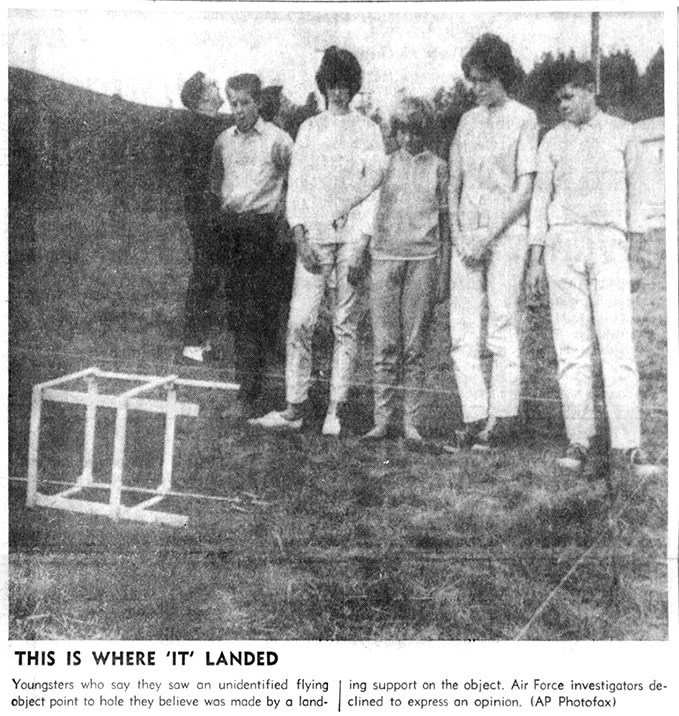
The April 29, 1964, multi-witness case involving five children at Canyon Ferry Village, Montana, was also called a hoax by an Air Force investigator.
 |
| The Billings Gazette, May 5, 1964 |
March 2, 1965: John Reeves of Brooksville, Florida, claimed to have seen a landed saucer and met the aliens.

After Project Blue Book investigated Reeves story, “it is the opinion of the Air Force that an attempt was made to perpetrate a hoax.”
Rex Heflin took several UFO photos on August 3, 1965, and during the publicity that followed, Hector Quintanilla said Blue Book had investigated and, “We have classified it as a photographic hoax.”
 |
| Rex Heflin and one of the photos that brought him fame. |

Dan and Grant Jaroslaw said they photographed a UFO on January 9, 1967, at Mount Clemens, Michigan. The Air Force didn’t say hoax, but after investigating, Dr J. Allen Hynek said there was “considerable doubt on the sighting and removes it from serious consideration.”
 |
| This Week, March 5, 1967 |
Immunity from Exposure
The findings of the government-contracted UFO evaluation led by Dr. Edward U. Condon was published as Scientific Study of Unidentified Flying Objects. It essentially followed the Air Force’s policy by not naming the witnesses in discussing the cases it examined. The study reached a negative conclusion on the value of the government continuing UFO research. As a result, Project Blue Book was closed in 1969. For a few years the UFO business was quiet, but in 1973 things heated up again. Without Project Blue Book to serve as a scarecrow, hoaxers had the run of the field.
 |
| Hattiesburg American (Mississippi) Oct. 19, 1973 |
We’ll close with a quote from Ed Ruppelt. His files also contained the original and revised drafts for his 1956 book. After his section on the 1947 Maury Island case, on page Ruppelt wrote:
"So long ago that nobody knows why, the government established a policy not to comment on anything that is written or said by private citizens. People can make any fantastic claim with a relatively high degree of immunity to being exposed…
This policy has been a bonanza to the writers of saucer lore. The basic concept of 'saucerism vs. the Air Force' warfare is to print or say anything and as proof of your honesty, dare the Air Force to contradict you."

For whatever reason, those paragraphs were cut from Ruppelt's printed book.
. . .